


Recent news coming out of Indonesia was the shocking revelation of the NGO Cartel that extorts from firms to the point of scaring away investors.
The Government has stepped in to declare it a national crisis and accused these NGOs of economic sabotage.
An exposé by Kompas detailed the modus operandi as “rampant and coercive thuggery” where organisations exerted pressure on companies and business owners to pay them protection fees or award contracts to undeserving parties.
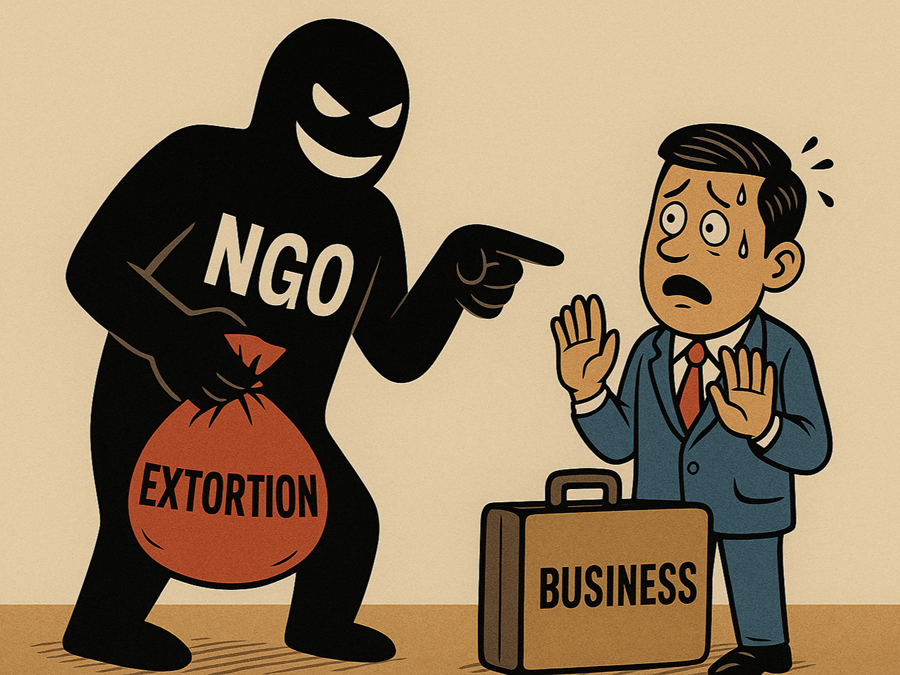
Methods include holding mass protests, slander via social media and the Press and even police reports and frivolous lawsuits.
There were even occasions when they attended shareholders’ meetings as fake proxies to create chaos.
They also held protests at factories and offices of these companies that refuse to play ball.
In Malaysia, cases of similar extortion have gone largely unreported but not unnoticed.
In many cases of NGOs naming and shaming corporations, including public listed ones, there was always a hidden agenda.
Their agenda is not to fight corruption or defend workers’ rights or stand up for shareholders against the tyranny of corporate monsters.
But a simple due diligence and deep dive will reveal that there is usually a vested interest, and money is always at the centre of it.
These include a demand for a percentage of profits without even doing any work; reinstating a business arrangement that fell through; settling a contractual dispute; covering up for subpar work; the list goes on.
These NGOs will be used by vested parties to act as “pressure groups”, to bring the companies to the negotiation table and pay up.
They are hoping the publicity, which is bound to create anxiety among shareholders and business associates, will force these firms’ backs against the wall.
In some cases, physical threats are lobbed at company executives.
It is understood that police reports were made by a public listed firm recently over death threats to several senior executives.
According to media reports, there are 95,694 NGOs registered in Malaysia. That is quite a number for a population of 32 million. Indonesia has 550,000 to its 280 million population.
How many of these organisations are actually doing activities consistent with their charter of championing causes, workers and the respective industries?
And how many are set up essentially as triad societies to “pao” companies, individuals and even small businesses?
Over a decade ago, when a famous Chinese-run family kopitiam in Johor faced a PR nightmare when non-halal elements were discovered in the butter, an NGO quickly stepped in to help quell protests.
Its quid pro quo was to make one of their founders the chairman of the company and go for halal certification.
In Malaysia, using the Bumiputra card is a favourite tool as it is bound to evoke sentiment and even put the government and authorities on the back foot.
There are many good organisations out there that are doing good work and are deservedly getting their funding from the government and private sector.
Unfortunately, in the mix are dubious outfits that are used as fronts to cheat, extort and enrich a few.
A recent example is Aman Palestine, which was raided by the Malaysian Anti-Corruption Commission (MACC) and saw its executives charged with embezzlement involving almost RM40 million!
There are other heads of NGOs who are also facing charges of embezzlement and criminal breach of trust, among others.
For instance, Datuk Mohd Ridzuan Abdullah of NGO Ikhlas is facing charges of falsification of documents for Socso claims.
So, now comes the role of the Government, specifically the Registrar of Societies under the Home Ministry. Who is monitoring these NGOs, and what criteria are being employed to approve them?
In Indonesia, the Probowo government launched an anti-extortion task force comprising, among others, the police, the anti-corruption agency, investment agencies, the human resources ministry and even the armed forces.
The government there is showing it means business.
Back home (in Malaysia), perhaps it’s time for the government to follow Indonesia’s lead and put these NGOs under the radar to ensure they are indeed who they say they are and not a mafia outfit dressed as do-gooders.
 This article originally appeared on Scoop.my and was written by Terence Fernandez, Group Editor-in-Chief of Big Boom Media, which publishes Scoop.my.
*Disclaimer: The views expressed are those of the writer and do not necessarily reflect those of NHA – News Hub Asia.