


A new agreement between Education Malaysia Global Services (EMGS) and All Nippon Airways (ANA) is expected to ease the journey for international students travelling between Japan and Malaysia, as both countries deepen cooperation in education and tourism.
The Memorandum of Understanding (MoU), signed in Putrajaya last week, formalises a strategic collaboration to promote Malaysia as a study destination, while offering enhanced support to international students based in Japan, including Japanese nationals and third-country students.
For Malaysia, this initiative aligns with efforts to position the country as a regional education hub. Japan, meanwhile, is pushing to increase global exposure for its students through outbound mobility, particularly within Asia.
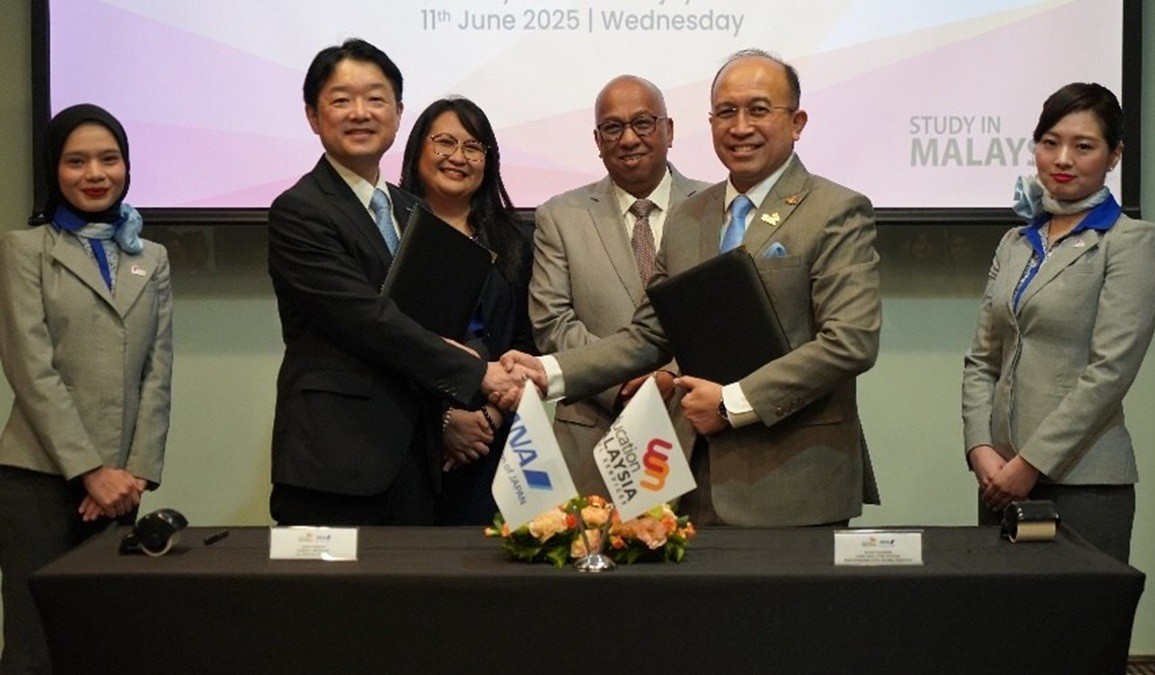
“We are seeing a steady increase in applications from Japan, with mobility programme participation rising by 24 per cent, which is the highest to date,” said EMGS chief executive officer Novie Tajuddin. She added that the partnership “opens new doors for Edutourism and international engagement, making it easier for students to explore academic and cultural experiences in both countries, benefiting not only Japanese students, but all international students in Malaysia.”
The collaboration goes beyond marketing. EMGS and ANA plan to jointly roll out campaigns, events and student-centred travel benefits to encourage greater interest in Malaysia’s tertiary education sector, which currently hosts, according to the Ministry of Higher Education, over 131,000 international students from more than 150 countries.
ANA, Japan’s largest airline group, framed the partnership as part of a broader vision to support educational and cultural exchanges. “This MoU is not just about air travel, it’s about bridging people, knowledge, and cultures,” said Akira Tamura, ANA’s general manager. “We are honoured to support the Ministry of Higher Education’s vision through this meaningful partnership with EMGS.”
Observers in the education and travel industries view this agreement as part of a larger trend – one where student mobility, once seen as a niche segment, now plays an increasingly strategic role in regional cooperation.
As education and travel become increasingly intertwined, partnerships like this signal a growing shift in how countries promote talent mobility and soft diplomacy. With Asia at the centre of rising cross-border student flows, initiatives that combine education and aviation are likely to shape future strategies in both sectors.