


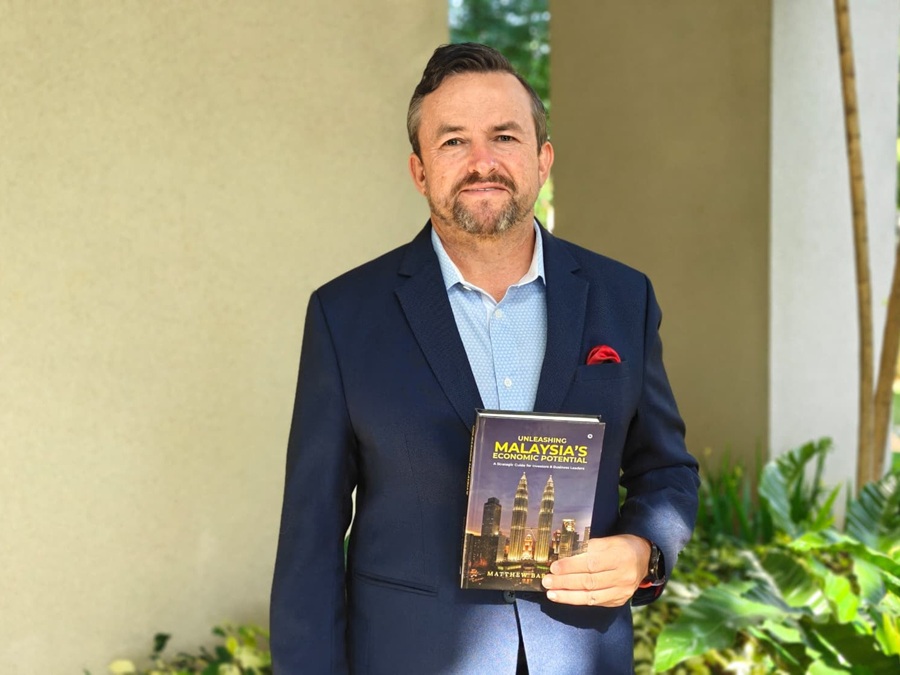
In an era defined by global uncertainty, rapid digitisation, and shifting trade alliances, Malaysia’s long-term economic trajectory will depend not just on policy reforms but on the nation’s ability to align institutions, talent, and technology around a shared vision. That’s the central message of Unleashing Malaysia’s Economic Potential, a newly published book by Matthew Barsing, an economic strategist and advisor with over two decades of experience across Malaysia, Central Asia, and ASEAN in public policy, digital transformation, and investment advisory. This is his debut book.

Described as both a blueprint and a wake-up call, the book offers Barsing’s grounded perspective on how Malaysia can reimagine its growth model amid fierce regional competition from Vietnam, Indonesia, and Thailand. Drawing on his experience at the Malaysia Digital Economy Corporation (MDEC), his current role at EPS Malaysia, and his work with governments in countries like Uzbekistan, Barsing’s ideas are not theoretical. They are a call to action for policymakers, investors, academics, and business leaders across the region.
“This book was born from two decades of work in Malaysia’s economic development landscape—across investment promotion, bilateral trade, and talent development,” Barsing said in an interview with News Hub Asia. “I’ve seen firsthand the immense potential this country holds, but also the structural and mindset shifts needed to unlock it.”
At the heart of the book lies a critique of fragmentation. Barsing points to a lack of coordination between federal, state, and private sectors, which he argues has stunted Malaysia’s ability to execute even well-designed policies.
“The biggest obstacle is fragmentation—of policy, of execution, and sometimes even of vision,” he said. “To overcome this, we need bold leadership that embraces integrated planning, data-driven decision-making, and transparent collaboration. If we can align incentives and institutions, the rest will follow.”
The book navigates five key pillars: digital transformation, ESG integration, regional investment strategy, infrastructure reform, and talent development. It is written with a practical tone and includes case studies such as Penang’s evolution into a regional technology hub, a success Barsing attributes not just to tax incentives, but to long-term ecosystem thinking “sustained through investment in talent, infrastructure, and industry clusters”.
He explained that it was the ecosystem approach that worked in Penang, “…including public-private partnerships and education linkages. This model can be replicated in other states if there’s commitment to long-term planning and regional strengths.”
A digital urgency
While Malaysia’s energy transition and ESG adoption are acknowledged as critical, Barsing is adamant that digital transformation must take precedence.
“Digitisation isn’t just about tech—it affects governance, investment attractiveness, SME competitiveness, and youth employability. Once digital foundations are strong, ESG practices and regional partnerships become more scalable and credible,” he said. “Without it, we risk falling behind regionally.”
He adds that ASEAN neighbours, and even non-traditional benchmarks like Estonia, are forging ahead in ways that Malaysia should be learning from more intentionally.
Talent over location
The book’s findings are peppered with hard truths. One key insight that surprised Barsing was that Malaysia’s biggest strength is not just its location, but its people, though this asset remains underinvested.
Other findings include growing investor interest in governance and ESG factors, as well as a strong but often siloed appetite for reform within the public sector.
From piecemeal to ecosystem
What does Barsing want readers, particularly those in government and corporate boardrooms, to take away from the book?
“I’d ask them to move from piecemeal reforms to ecosystem thinking. Instead of fixing issues in isolation, let’s design integrated, data-driven frameworks that support sustainable growth—across digital, green, talent, and trade. We have all the pieces. Now is the time to connect them,” he urged.
Unleashing Malaysia’s Economic Potential is now available at a special pre-launch price of RM49 (normal price RM79) for Malaysian readers via Notion Press. International readers can purchase the book through Amazon (UK, US, and India) and Flipkart.