

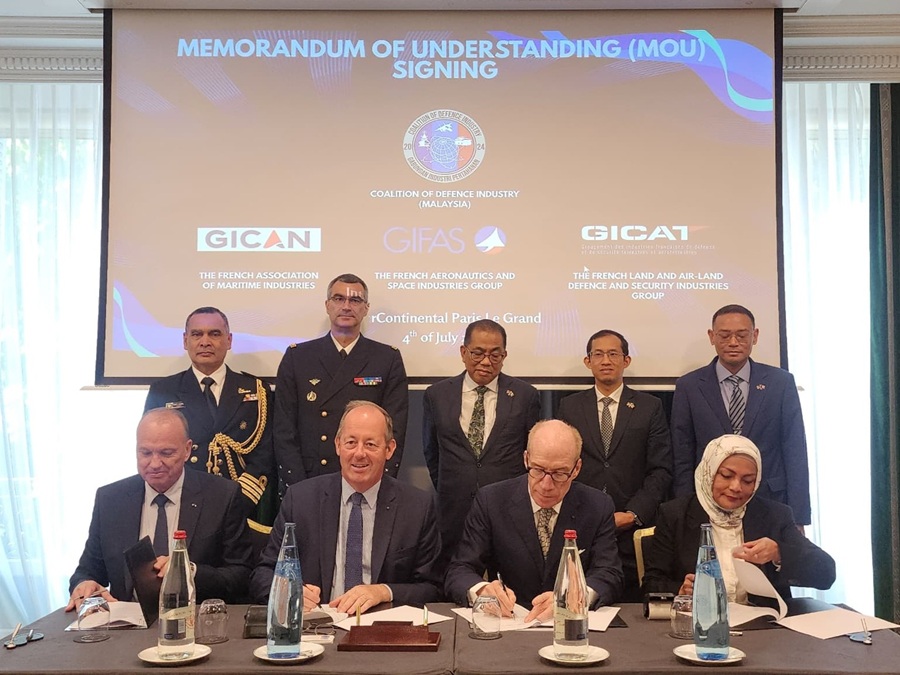
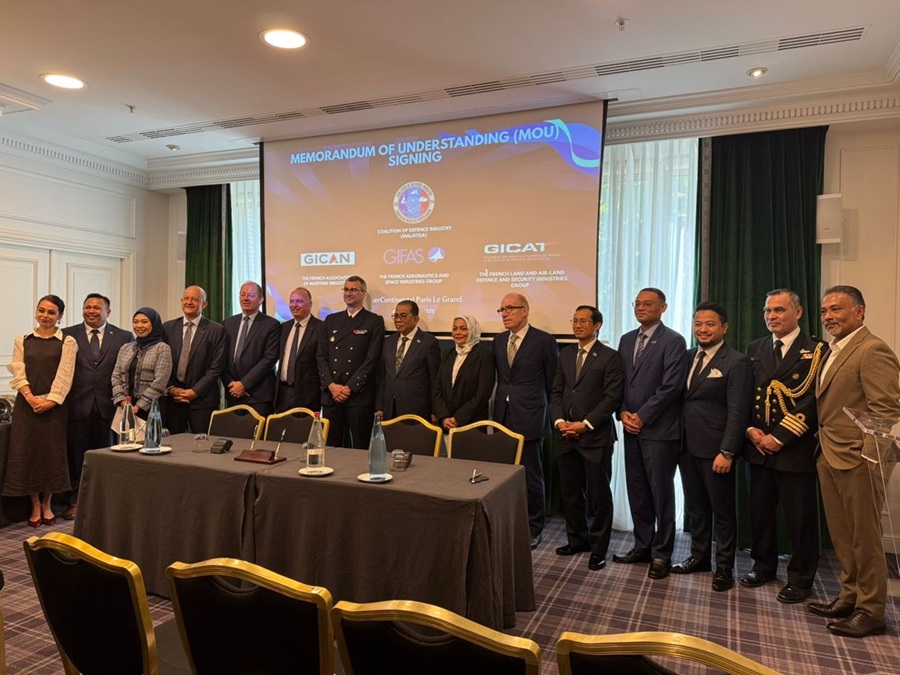
In a major move set to redefine bilateral defence cooperation, Malaysia’s Coalition of Defence Industry (CDI-M) has signed a Memorandum of Understanding (MoU) with three of France’s leading defence industry associations – The French Association of Maritime Industries (GICAN), The French Land and Air-Land Defence and Security Industries Group (GICAT), and The French Aeronautics and Space Industries Group (GIFAS) – marking a pivotal step towards enhanced strategic alignment, technology transfer and regional engagement.
The agreement, signed in Paris on the sidelines of an official visit by Malaysian Prime Minister Datuk Seri Anwar Ibrahim, was witnessed by Defence Minister Datuk Seri Mohamed Khaled Nordin. It underscores a shared vision between both countries to strengthen industrial cooperation across aerospace, maritime, and land-based defence technologies, areas seen as critical to regional security and innovation.
Speaking on the milestone, Datuk Nonee Ashirin Mohd Radzi, president of CDI-M and executive chairman of Global Turbine Asia, said, “This agreement is a strategic milestone for Malaysia’s defence sector. It reflects our ambition to grow global partnerships. By working closely with our French counterparts, we are not only enhancing our industrial capabilities but also opening new pathways for innovation, upskilling, and global market access.”
The MoU lays the groundwork for sustained bilateral collaboration, including regular technical dialogues, the creation of a bilateral industry club, training exchanges, joint research and development initiatives, and efforts to access regional and global markets.
From the French side, key figures in the defence industry expressed strong optimism about the deal’s long-term impact. Philippe Berterottiere, president of GICAN and chief executive officer of Gaztransport & Technigaz, noted, “Malaysia is an increasingly important player in the global defence landscape. Through this MoU, we aim to build durable industrial relationships that go beyond technology, partnerships rooted in trust, innovation, and shared prosperity.”
Nicolas Chamussy, chairman of GICAT, added, “This collaboration provides a unique platform to align our expertise with Malaysia’s strategic goals. We are particularly excited to pursue and intensify joint opportunities in land and air-land defence systems.”
Echoing these sentiments, Fréderic Parisot, chief executive officer of GIFAS, pointed to aerospace as a key priority. He said, “Aerospace collaboration is critical in today’s security environment. We believe this MoU lays the foundation for impactful cooperation in research, training, and future-ready capabilities between France and Malaysia.”
Lieutenant-General Gaël Diaz de Tuesta, France’s National Armaments director, further highlighted flexible partnership models to suit various project needs — from French-led initiatives with Malaysian suppliers, to Malaysian prime contractors working with French OEMs, mirroring the model used in Malaysia’s Littoral Combat Ship (LCS) programme.
A strategic shift for the ASEAN defence industry
This Franco-Malaysian pact comes at a time when ASEAN nations are recalibrating defence strategies amid rising geopolitical complexities and emerging threats. Malaysia’s move to formalise deeper ties with French defence leaders signals its broader intent to boost regional readiness while positioning itself as a credible industrial player in the South East Asian defence landscape.
Beyond security, the deal is expected to stimulate economic growth by promoting upskilling, job creation, and increased foreign investment in Malaysia’s defence sector – a key pillar under the country’s national industrial development strategy.
The collaboration is also likely to have ripple effects across ASEAN as member states seek to modernise their defence capabilities while balancing global partnerships.
With this MoU, Malaysia strengthens its ambitions to become not just a consumer of defence technology but a key contributor to the regional defence value chain, one that brings together innovation, capability development, and cross-border cooperation.