Home Blog Page 143

Malaysian-Turkish Seed Sector Meeting

logo

Malaysian-Turkish Seed Sector Meeting

The 36 strong delegation is lead by the Turkish Sub Union of Seed Industrialist and Producers (TSÜAB) will conduct a business matching meeting and engagement program on the 29th of October at the Westin Hotel in Kuala Lumpur.

imageThe members of Turkish Sub Union of Seed Industrialist and Producers (TSÜAB) are leading producers and have developed expertise in the areas of crop yeild improvement, variety improvement, registration of varieties, producing and packaging of seeds in both local and international markets.


Invitation Letter Malaysia (October,29 2015)

Phone
+603 425 95 000

Fax
+603 425 72 227

To receive more information please fill in the form below

    Purchasing Wednesday

    The Malaysia Global Business Forum (MGBF) is organising a specialized event to assist both the corporate sector to supply and to assist the broader purchasing community to identify new products & services from the most cost effective suppliers.

    ‘Purchasing Wednesday’ Networking Lunch & Discussion Session has been designed to be enjoyable and an effective use of a lunch hour by networking the business development community with the purchasing community, with the goal of improving the bottom line and sustainability from both sides of the equation.

    If you are a CEO of an SME, a director of business development, a sales manager or running your own business this program is designed to assist you, by assisting to develop the relationships with the people who are in charge of buying and procurement and all at a very affordable cost.

    The following are the details of the program for the upcoming ‘Purchasing Wednesday’

    Date      15th of June, 2015
    FormatShort Panel Discussion followed by Networking Lunch
    Time    12:00pm to 2:30pm
    LocationAryan Restaurant, 76, Jalan Raja Chulan, Kuala Lumpur (next to Quality Hotel)
    Participation Individual
    Fees RM200
    BenefitsOne (1) Pass & List of All purchasing people attending (post event)
    Participation Group
    FeesRM1,500
    Benefits        Ten (10) Passes, List of All purchasing people attending (post event), Logo on backdrop

    Your participation will allow you to build the relationships with the purchasing decision makers that will improve your business development, sales numbers and the bottom line. Click this link to download the booking form

    Tailored Solutions for Business Development

    Should your company or organisation need a tailored solution or a strategy to expand market share in the industry sector that you are operating in the Malaysia Global Business Forum has the experience and know how to assist.  We have assisted Malaysian SME’s develop new business in Malaysia and in international markets in ASEAN, Middle East and Europe.  We have assisted many International companies and trade associations enter the Malaysian market in various industries.

    [contact-form][contact-field label=’Name’ type=’name’ required=’1’/][contact-field label=’Email’ type=’email’ required=’1’/][contact-field label=’Website’ type=’url’/][contact-field label=’Comment’ type=’textarea’ required=’1’/][/contact-form]

    Malaysia Global Business Forum GreenTech Investment

      Supply Chain & Investment into Food Production


      South Australian Food Delegation

      The three mega global trends of population growth, demand created by the economic shift of Millions out of poverty and the volatility of the environment have set the stage for a new era in global food security. This is changing how companies and countries invest into food production. What affects will the Trans Pacific Partnership Agreement (TPPA) have on food production and Investment?top website banner-food secure

      Extracts from a recent interview with Nordin Abdullah:

      What is the “Changing Paradigm in the Global Supply Chain”?

      Food based inflation has become a real issues for nations to manage, it is something that the population has to deal with on a daily basis so they really feel it at the end of the month. A hungry population is an angry population, we saw this in the Arab Spring. Food based inflation was the tipping point that kicked this off in Tunisia. The problem is that global corporations are the major players in the global supply chain, they are the largest investors and control much of market so it is increasingly difficult for governments of the world to have a positive impact which improves the supply to the point that it reduces food prices for consumers.  Then take all of that and multiple it by climate change and we see the changing paradigm of food security.

      How will the Trans Pacific Partnership Agreement or the TPPA affect Malaysia and ASEAN?

      The Trans Pacific Partnership Agreement of the TPPA in the short term will have minimal effect on the Malaysian Economy, mostly due to the fact that it will take several years before most of items with regards to food and agriculture will come into affect. Likewise the size of companies that are currently in the agri-food space in Malaysia will be exempt from most of the conditions.  Areas that Malaysia will need to strength will be intellectual property and packaging legislation. Halal has also been exempted.

      What is changing in terms of food producers’ understanding of consumer’s needs and how does that affects the supply chain and the thinking about investments? 

      Along with population growth, we are witnessing in many parts of the world Millions of people being elevated from poverty and Millions entering the middle class, this has changed consumer’s behaviour.  Now the demand for proteins and processed foods has grown rapidly, According to USDA’s baseline projections, developing countries will account for much of the increase in projected growth in global consumption of meats and crops in 2013-22 period. The developing-country shares of the projected growth include 81 percent for meat, 83 percent for grains and oilseeds.  This has created an opportunity and the thinking around investment into that part of the global food supply chain.

      What are some of the specific opportunities that this has created and what strategies will be successful?

      I like to think about it on two levels, the first is what are countries doing to improve their domestic food production, no doubt most countries will be able to produce all their food requirements but improving levels of self-sufficiency is important.  There are several countries which need to look at other strategies due to population or resources constraints, they will need to look at investing and controlling to the point of ensuring supply of strategic food resources for their population.  Both will require increased investment and increased understanding of food production, technology, logistics and the various financial models of each crop.  To understand the current gap, the FAO estimates that USD83 Billion per year of additional investments in food, agriculture and rural development are required for the world to feed its growing population in 2050

      How successful can Malaysia be in this context, what can corporations expect?

      In terms of food security Malaysia has achieved a lot, in the context of a country coming out of developing world they have created a strong base in terms of the Palm Oil Industry and its’ global supply chain. Malaysia currently accounts for 39 % of world palm oil production and 44% of world exports. If taken into account of other oils & fats produced in the country, Malaysia accounts for 12% and 27% of the world’s total production and exports of oils and fats, this with a population just under 30 Million people. Now Malaysia needs to replicate that success with other products.

      Malaysia has for the past decade positioned itself as the Global Halal Hub, how successful has this project been? 

      The demand for food in the Muslim World is high because many Muslim majority countries have low levels of self-sufficiency, this is the market that Malaysia is aiming to conquer.  This will not be done overnight as there are many barriers that need to be overcome both trade and technical, the key to success will be the amount of investment that the country will be able to attract to achieve its ambitions.

      What is technology doing to improve food security? 

      Technology, Standards and understanding the energy equation will be the key for success for companies looking to play a leading role in this sector.  While the ‘Cloud’ has made the world flat it has also increased the technology requirement for food producers.  Global food retailers want to have traceability from farm to fork and a myriad of standard compliance on various levels for suppliers because the high-end consumers in Europe and America are demanding these standards, so suppliers need to understand the full requirements of a market not just the fact that they want a specific food item.  There is a lot of things changing that is the opportunity and the risk.

      IMG-20150911-WA0000Nordin Abdullah is the Managing Director of Glenreagh Sdn. Bhd.

      A boutique consultancy firm based in Kuala LumpurNordin has a passion for Sustainable Development coupled with over 15 years of experience in Food Security and Halal Industry development he brings a unique perceptive to the discussion of food security in the developing world. “Now there is a real need to drive more investment into the sector or we risk missing the opportunities that the global trends have created” 

        Latest Export Data: Australian companies choosing Malaysia


        Leigh Howard, Chairman, MABCEarlier today, the Australian Bureau of Statistics published their latest data set, revealing Australian company export figures. In 2013-14, a total of 3,801 Australian companies were recorded as exporting their goods and services to Malaysia, compared to 3,659 in 2012-13. This is an annual growth of almost 150 companies.
        These figures, when contrasted with other key players in South East Asia and neighbouring regions, tend to suggest that Malaysia is increasingly becoming a prime destination for Australian companies. In 2012-13, Thailand had 2,851 Australian exporters, this figure dropping by 40 to 2,811 in 2013-14. Indonesia also recorded a decline with 2,421 companies exporting in 2013-14, compared to 2,500 in 2012-13. India and Japan also experienced a decline in numbers. In 2013-14, India recorded 1,865 Australian exporters and Japan recorded 3,016. Whilst Singapore is one of Australia’s largest trading partners, it experienced less growth than Malaysia, with only an extra 48 companies exporting in 2013-14.

        “This is a significant indication of the strengthening of the Malaysia-Australia trade relationship” stated Leigh Howard, Chairman of the Malaysia Australia Business Council (MABC). “Many people would be surprised to learn that more Australian companies export to Malaysia than export to other countries such as India, Japan, Indonesia, and South Korea. It is a testament to the openness of both economies and the enduring strength of the trade relationship over many decades.”

        Howard also cited the Malaysia Australia Free Trade Agreement (MAFTA) as a contributing factor. “There is no doubt that MAFTA has been a growing success which has resulted in tangible benefits for businesses in both countries.” Whilst the trade statistics already indicate strong growth, they are likely to increase when the Malaysian Government reduces tariffs on 99% of goods imported from Australia in 2017. Malaysian goods currently enjoy duty-free treatment in Australia. Other sources indicate that Malaysia has 2,600 local companies exporting to Australia

        For more information contact [email protected] or visit www.mabc.org.my

        Print

          The Business of Mother’s Day

          Something Special or Just get Flowers

          Unlike your wife’s birthday, Mother’s Day you will not miss. Why, the marketing world will not allow you to, it’s one of the global marketing events of the year and its getting bigger each year.  So what is the business of Mother’s Day, how can your business take a slice of the action and is there room for improvement on the one day in the year that we turn the our focus to the one person who did so much to get us where we are today? (Ohhh… The power of guilt even an introduction about Mother’s Day has to have it)

          Mother's Day BusinessWhile in Malaysia the Mother’s Day market is not as big as the USD21 Billion market but it is as equally powerful, a few days before the big day all red roses were sold out in a leading distributor in the Petaling Street area of Kuala Lumpur and forget trying to get a hand bouquet, the only ones available were made of teddy-bears.  Several restaurants in many of the capital’s high-end shopping malls are on a reservation only basis and with set menus that are a good amount over a regular meal. Which make people wonder about all the hype around the recent introduction of the GST, no such concerns for a 6% tax during this time.

          This is on the domestic consumption level, the question remains how are Malaysian flower producers and other related exporters gearing up for this spike in demand? According to recent research, the total area under cut flowers is estimated to be over 1,218 hectares, out of which 580 hectares are under orchids and 638 hectares are under temperate cut flowers including roses.  In terms of number of flower stalks, temperate flowers contribute 71.46% towards the total cut flower production while the remaining 28.54% is from orchids.

          The major production areas for temperate cut flowers are in the Cameron Highlands, in Pahang state where the Cameron Highlands Floriculturist Association and the Commercial Orchid Growers’ Association of Malaysia is the heavy hitter.  Currently they do not collectively market their produce however there is growing realization of the benefits of such marketing arrangement.  In other cases several temperate flower producers have grouped together to form a trading company to deal directly with importers in foreign countries.

          Moving forward there is a huge scope for improvement in terms of brand positioning, investment promotion and supply chain management, the spoils will be there for companies who can get it right.

          Nordin Abdullah is an Australian entrepreneur with over two decades business experience in Asia, the Deputy Organising Chairman of the Malaysia Global Business Forum and the Managing Director of Glenreagh Sdn. Bhd. a boutique consultancy firm based in Kuala Lumpur, to arrange a time to discuss how the team at Glenreagh can assist your organisation


            Malaysia Global Business Forum Appoints New Chairman

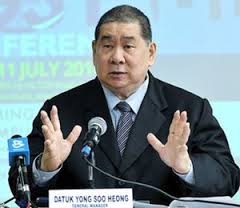
            The Malaysia Global Business Forum (MGBF) announced that it has appointed Datuk Yong Soo Heong as its Chairman who retired as Chief Executive of BERNAMA upon reaching the mandatory retirement age of 60 for government employees in October 2014.Datuk Yong Soo Heong Profile

            He has been in journalism for the past 40 years, starting as a journalist with the Straits Echo in Penang and later joined BERNAMA where he made his mark in his career. Yong was BERNAMA’s Editor-in-Chief from 2007 to 2012, making him the first BERNAMA business journalist to rise to that position before being elevated to Chief Executive in 2013.

            Commenting on his new role, Yong said: “This will be an extension of my career as gives me time to also interact with people who make things happen.  As Malaysia aspires towards developed nation status, I find that we have to learn more from people who have been at the top of their game. This is where I come in, bringing people who matter to share their insights and experiences with Malaysians through our forums.”

            While the MGBF will continue to act as a platform for “Strategic Business Development” and a place to “Meet the Right People” with the appointment of Datuk Yong as Chairman will ensure that the forum has a greater impact and contributes more to the economic development of the nation.

            Since the inaugural forum which was held in 2009 the MGBF have organised several industry and country specific forums including dedicated business matching programs.  The MGBF have also participated and lead several overseas trade and investment trips for Malaysian companies expanding their market share in the region and around the globe.

              What Opportunities does a Green China Create?

              Shaping Business Green - Driving Investment BannerAs the stories of air pollution and environmental degradation continue to flow out of China, the question remains what is being done to fix it?  Bringing the problem to a common denominator is often the first step in the long process of a solution, as the following extracts from the Green Economy Report shows that the wheels have started to turn.

              Chinese policy makers have in recent years introduced green credit guidance for the country’s banking sector and environmental liability guidance for the insurance industry. China’s leading banks are working to operationalise revised credit assessment systems across their main business lines. Also, the country’s city-based commercial banks, rural banks and cooperatives are involved in greening the country’s credit system. Similarly, 20 of the country’s insurers are actively exploring new environmental liability insurance products and services, while a series of pilot environmental insurance initiatives have been carried out with a number of provincialimgres and municipal authorities around the country.

              The China Banking Regulatory Commission (CBRC) is tasked with regulating and supervising banks and non-bank financial institutions. In 2007, CBRC introduced Energy Conservation and Emission Reduction regulations requiring financial institutions to establish an organisational framework and internal procedures to advance green criteria. Among other things, the CBRC’s regulations require a senior banker in each regulated institution to be responsible and accountable for green credit as well as to boost lending to the renewable energy and green sectors.

              The CBRC sees two roles for the institutions it regulates. First, through lending to facilitate new energy sectors such as wind and solar. Second, by imposing restrictions on clients that are noncompliant with environmental laws and regulations and by withdrawing existing lending in extreme cases. Banks are required to submit a report to CBRC annually to outline their advances in the area of green credit and in turn the regulator reports developments to the State Council. The CBRC encourages its regulated institutions to apply international protocols that support sustainability in financial services.  The role of international financial institutions in supporting the greening of the Chinese financial sector is important. For example, the Industrial Bank of China, Pudong Development Bank, and Beijing Commercial Bank have worked closely with the IFC to advance energy efficiency projects. The IFC provides guarantees and assists the banks in preparing for CDM projects.

              The Industrial Bank of China estimates that over two years the reduced CO2 emissions from its energy efficiency projects is equivalent to the total emissions of the Beijing taxi fleet. On the banking side, ICBC, the largest bank in the world by market capitalisation, has created a Green Credit Policies Department in an effort to become the leading green bank in China. In addition, the bank is active in disaster relief and rural education. On green credit, ICBC classifies clients into nine categories and has a colour coding system – black, green, red, and grey – to assess eligibility for credits.

              Moving forward, how will companies from the rest of the world, Malaysia included participate in the greening of the Chinese Economy?

                First Announcement – MGBF “Shaping Business Green – Driving Investment”

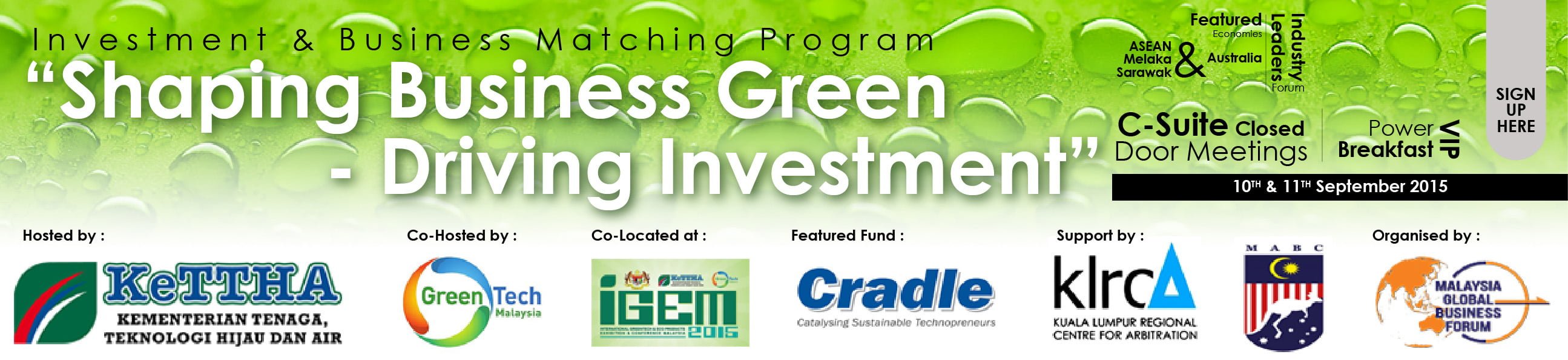
                The next edition of the Malaysia Global Business Forum will be themed “Shaping Business Green – Driving Investment” this one day event will be held on the 11th of September in KLCC Convention Centre.

                Hosted by Ministry of Energy, Green Technology and Water or KeTTHA and Co-Hosted by Green Tech Corp Malaysia the Forum will be co-located with the region’s most successful green economy exhibition IGEM.  Currently, the Forum also has support from the Australian Malaysia Business Council (MABC)

                The morning session of the full day event will be highly focused on green investment, green purchasing and current global trends in the green economy with the keynote address delivered by Yang Berhormat Datuk Seri Panglima Dr. Maximus Johnity Ongkili the Minister of Ministry of Energy, Green Technology and Water. 20141019_114351-1

                The afternoon session will be strictly business and investment matching with a focus on matching investors with green technology innovators and those companies looking to expand market share in Malaysia and Asia.

                The Malaysia Global Business Forum would also like to welcome incoming chairman Datuk Yong See Heong who joined the MGBF team earlier this year after he retired as the CEO of the national news agency, Bernama.

                Moving forward we would like to explore collaboration with your organisation for more information visit the following link

                  High Level Business Matching – How it works

                  The Malaysia Global Business Forum has a proven approach for delivering results and is an integral part of a wider engagement to drive development.  While business development budgets and marketing budgets have faced pressures due to the current economic conditions, KPI’s targets, and organisational goals have not shifted, companies need a cost effective solution to address this paradigm shift, The Malaysia Global Business Forum has been tailored to that goal.Construction Purchasing in ASEAN

                  Where in the value chain are we targeting and what are those investors and businesses looking for? Who are the key investors & what can Malaysia offer them in terms of opportunities.  These questions creates challenges at all levels including Governmental, Organisational and Individual levels,  what is needed is a systematic approach to solve these problems.  Addressing the motivation of various stakeholders and bringing them to the table.  For businesses to reach their goals a platform is needed to fill the current gap, the Malaysia Global Business Forum which focuses on tangible results will bring together:

                  To access the business and investment matching programs please fill in the form below:

                  [contact-form][contact-field label=’Name’ type=’name’ required=’1’/][contact-field label=’Email’ type=’email’ required=’1’/][contact-field label=’Website’ type=’url’/][contact-field label=’Comment’ type=’textarea’ required=’1’/][/contact-form]

                    Logistics Driving Growth

                    “Malaysia is the world’s 24th largest trading nation, which makes logistics industry paramount.  From the logistics infrastructure; ports, airports, highways and railways to the service providers and government regulators must come together to provide a total logistics solution ecosystem”

                    The role of logistics as a crucial factor in Malaysia’s trade and economic growth cannot be understated and its importance as an enabler of the nation’s trade-dependent and export-oriented economy cannot be overemphasised, yet many are still unaware of this fact.BUSINESS MATCHING - LED Lighting

                    As this global Multi-Billion Dollar industry grows the question remains, how will Malaysian companies facilitate and creates efficiency for the supply chains of global players and how will the stakeholders in Malaysia chart the future of the countries logistics sector?

                    Malaysia has long been seen as a gateway to ASEAN, and has a host of International agreements and a long history of global trade in a recent interview the Organising Chairman of the Malaysia Global Business Forum, Nordin Abdullah commented “Malaysia has the advantage of several free trade agreements with key nations such as Japan, Pakistan, New Zealand, India, Chile and Australia and all the ASEAN nations under AFTA.”

                    “Growth of the logistics sector in Malaysia is almost guaranteed as the economy is expected to grow between 5% and 6% annually in the coming years, while comparatively low compared to some Asian countries it is relatively high compared to the global average of 3.7%.”  he continued

                    Malaysia has well-developed Infrastructure according to the MIDA website “Infrastructure in Malaysia is designed to serve the business community; it is one of the best in Asia. Telecommunications network served by digital and fibre optic technology, five international airports (all with air-cargo facilities), well-maintained highways and seven international seaports make Malaysia an ideal springboard to the Asia-Pacific market.”

                    “Industries in Malaysia are predominantly located in over 500 industrial estates and Free Zones developed throughout the country. These zones are categorised as export processing zones, which cater to the requirements of export-oriented industries. There are also specialised parks that have been developed to cater to the needs of specific industries.”

                    Moving forward, while the prospects for Malaysia’s logistics sector are positive, there is much room for improvement. To enable the logistics sector to handle greater volumes of freight, to speed up the time taken to deliver goods across the supply chains and to lower the cost of this delivery, several improvements need to be made.  These issues and more will be discussed in the next episode of MGBF Industry Reports – “Inside Malaysia’s Logistics Industry”

                    Hosted, engaging and well researched content, in a high quality magazine format – MGBF Industry Reports are 30minute programs that will air on BERNAMA TV on weekdays at 11:00pm and later hosted on MGBF dedicated channel on YouTube, solves the cost vs reach problem for your organisation. Many companies are now taking the advantage of the benefits of television coupled with social media to achieve their communication goals.